

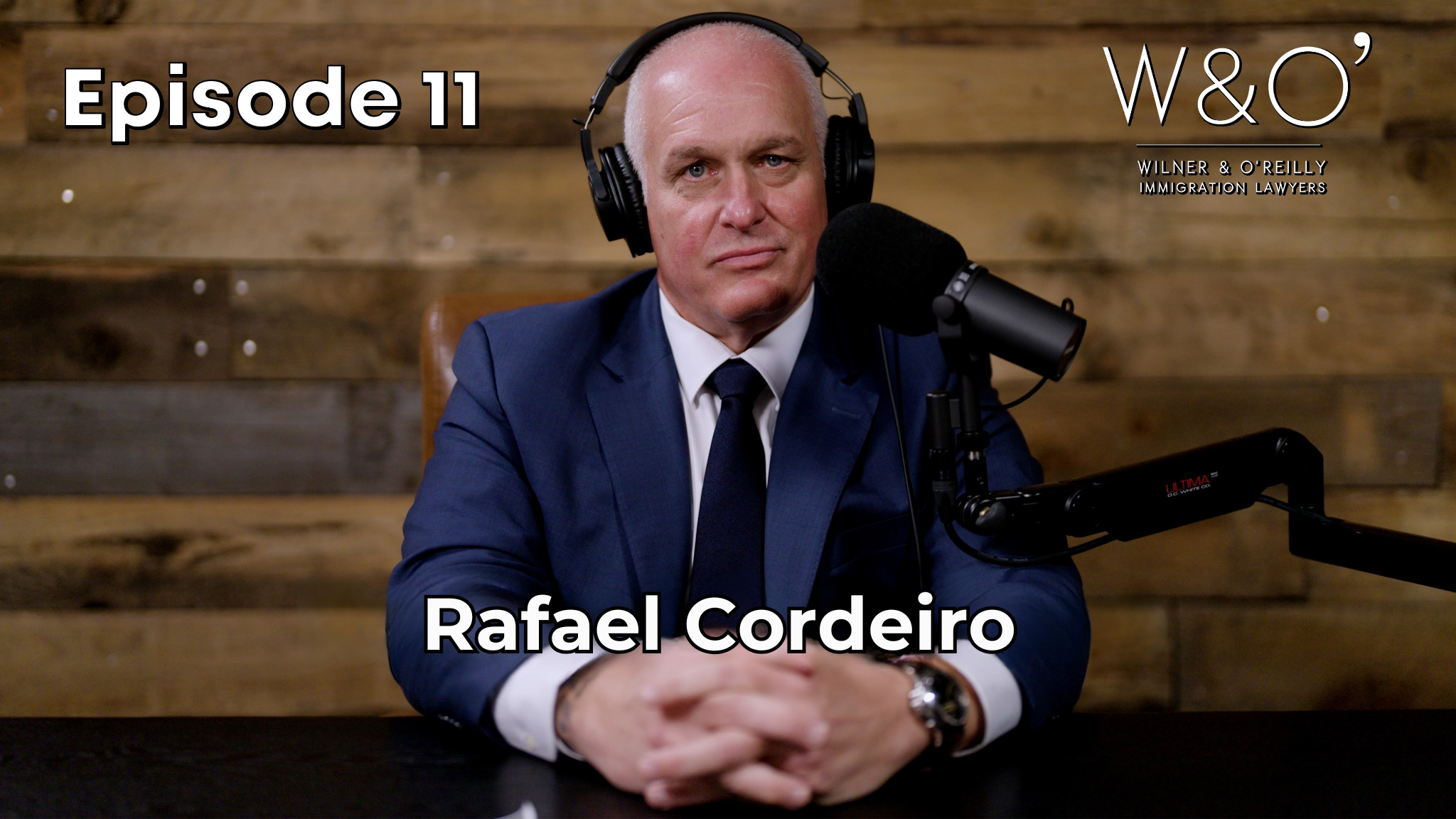
In Episode 11 of the ImmiGreat Podcast, Richard Wilner sits down with the first guest of the series—world-renowned MMA coach Rafael Cordeiro—for a powerful conversation about immigration, sacrifice, family, and building a legacy in America.
Today, Rafael Cordeiro is recognized as one of the greatest MMA coaches in the world. He is the founder of King’s MMA in Huntington Beach, a three-time Brazilian Muay Thai champion, a black belt in both Muay Thai and Brazilian Jiu-Jitsu, former Coach of the Year, and the coach of legends including Mike Tyson, Fabricio Werdum, Cris Cyborg, and countless world champions.
But long before the championships, international recognition, and King’s MMA, there was simply a man from Curitiba, Brazil, with a dream—and a plan.
As Richard explains in the episode, Rafael came to the United States through the O-1 visa, a visa reserved for individuals with extraordinary ability. From there, he pursued one of the most challenging immigration paths available: the EB-1 extraordinary ability green card, before ultimately becoming a United States citizen with his family .
This episode is not just about fighting. It is about what it takes to leave everything behind and build something from nothing.
What This Episode Covers
In this episode, Richard and Rafael discuss:
- Growing up in Curitiba, Brazil, and training at the legendary Chute Boxe gym
- How martial arts shaped Rafael’s discipline, leadership, and life philosophy
- Fighting and coaching across Brazil and Japan before considering the U.S.
- Why Huntington Beach became the place he chose to build his future
- How the O-1 visa created the first legal pathway to come to America
- Transitioning from an O-1 visa to an EB-1 extraordinary ability green card
- The challenges of starting over in the U.S. with no credit, no Social Security, and no established life
- The sacrifices his wife and daughters made during the immigration process
- Why following the correct immigration process mattered most
- Building King’s MMA from scratch during the 2008 financial crisis
- Coaching Mike Tyson and how that changed his career globally
- Becoming a U.S. citizen and what America means to him today
The O-1 Visa: Extraordinary Ability Opens the Door
Rafael’s immigration journey began with the O-1 visa.
The O-1 visa is designed for individuals with extraordinary ability in fields such as athletics, arts, science, education, and business. In Rafael’s case, it was not based on coming to the U.S. as a fighter—it was based on his achievements as a coach.
Richard explains that the strongest part of Rafael’s case was not just his own success in combat sports, but the accomplishments of the athletes he trained. For elite coaches, student success often becomes the strongest evidence of extraordinary ability.
That O-1 approval allowed Rafael to legally establish himself in the United States while his wife and children received O-3 dependent status .
As Rafael explains:
“I did nothing before my visa. I followed the protocol. I followed the plan.”
That discipline became the foundation for everything that followed.
Starting Over in America
Many people see success and assume luck.
Rafael tells a very different story.
When he first arrived in the U.S., he had no Social Security number, no credit history, no rental history, and no ability to easily rent an apartment, buy a car, or establish financial stability.
For the first several months, even basic life tasks were difficult.
At the same time, he was trying to rebuild a career he had already established in Brazil.
In Brazil, he was already a respected coach and martial artist.
In America, he was starting from zero.
He says:
“I was a champion in Brazil. Over here, I had to start everything again.”
That reality is one many immigrants know well.
Success in one country does not automatically transfer to another.
The willingness to begin again often defines the outcome.
Building King’s MMA from Nothing
Before King’s MMA became one of the most respected gyms in the world, it was simply an idea.
Rafael originally came to the U.S. connected to Chute Boxe, the legendary Brazilian gym where he trained from the age of 11. But eventually, he realized he needed to create something of his own.
That became King’s MMA.
He opened during one of the most difficult economic periods in recent U.S. history—the 2008 financial crisis.
Still, he never looked backward.
He focused only on what could be built next.
Early athletes like Fabricio Werdum, “Babalu” Sobral, and Cris Cyborg helped establish the gym’s reputation, and over time, King’s MMA became a global brand.
Today, the gym has locations in Huntington Beach, Austin, and Brazil, with a reputation that reaches across the world .
From O-1 Visa to EB-1 Green Card to U.S. Citizenship
One of the most important lessons in this episode is that immigration is not a single step.
It is a long-term strategy.
Rafael moved from:
- O-1 visa
- to EB-1 extraordinary ability green card
- to U.S. citizenship
That process required patience, compliance, planning, and sacrifice.
At one point, he could not travel back to Brazil for years while waiting for immigration approvals—even while his mother was battling cancer.
That kind of sacrifice is often invisible to outsiders.
But it is common in serious immigration journeys.
Rafael emphasizes repeatedly that doing things the right way matters:
“Everything that I have came from the right way that I did. I didn’t skip steps.”
That message is central to the episode.
Coaching Mike Tyson and Building Global Recognition
Years later, Rafael would become Mike Tyson’s coach.
For many, that moment represented global recognition.
But Rafael explains that Tyson was not the beginning of success, it was the result of years of preparation.
Training champions throughout his life prepared him for that opportunity.
He says:
“All the champions I trained prepared me to train Mike Tyson.”
Coaching Tyson elevated his visibility in both the United States and Brazil, expanding his reputation far beyond MMA circles.
But even then, he never changed how he treated people.
His philosophy remained the same: discipline, truth, humility, and full commitment.
What America Means to Rafael Cordeiro
One of the most powerful moments in the episode comes when Richard asks:
“What does the United States of America mean to you?”
Rafael’s answer is simple:
“This is my home.”
He explains that Brazil was where he was raised, but America opened doors for him, gave his family security, and allowed him to build a future.
He speaks about safety for his daughters, opportunity for his family, and respect for rules and structure.
He describes the United States as the place where dreams can become real, but only if people are willing to do things the right way.
His advice for immigrants is clear:
“Make a game plan before. Put everything on paper.”
That advice applies far beyond martial arts.
Watch or Listen
You can watch the full episode or listen to the audio version below:
About the ImmiGreat Podcast
The ImmiGreat Podcast, hosted by Richard Wilner, explores the real stories behind immigration law.
Each episode is designed to provide practical insight into complex immigration topics—from employment visas and green cards to deportation defense, detention, citizenship, and the personal journeys behind them.
Episode 11 reminds us that immigration is not just paperwork.
It is sacrifice, discipline, patience, and vision.
And sometimes, it becomes legacy.
If you are exploring an O-1 visa, EB-1 green card, employment-based immigration, or long-term immigration planning, contact Wilner & O’Reilly:
Comments are closed.