

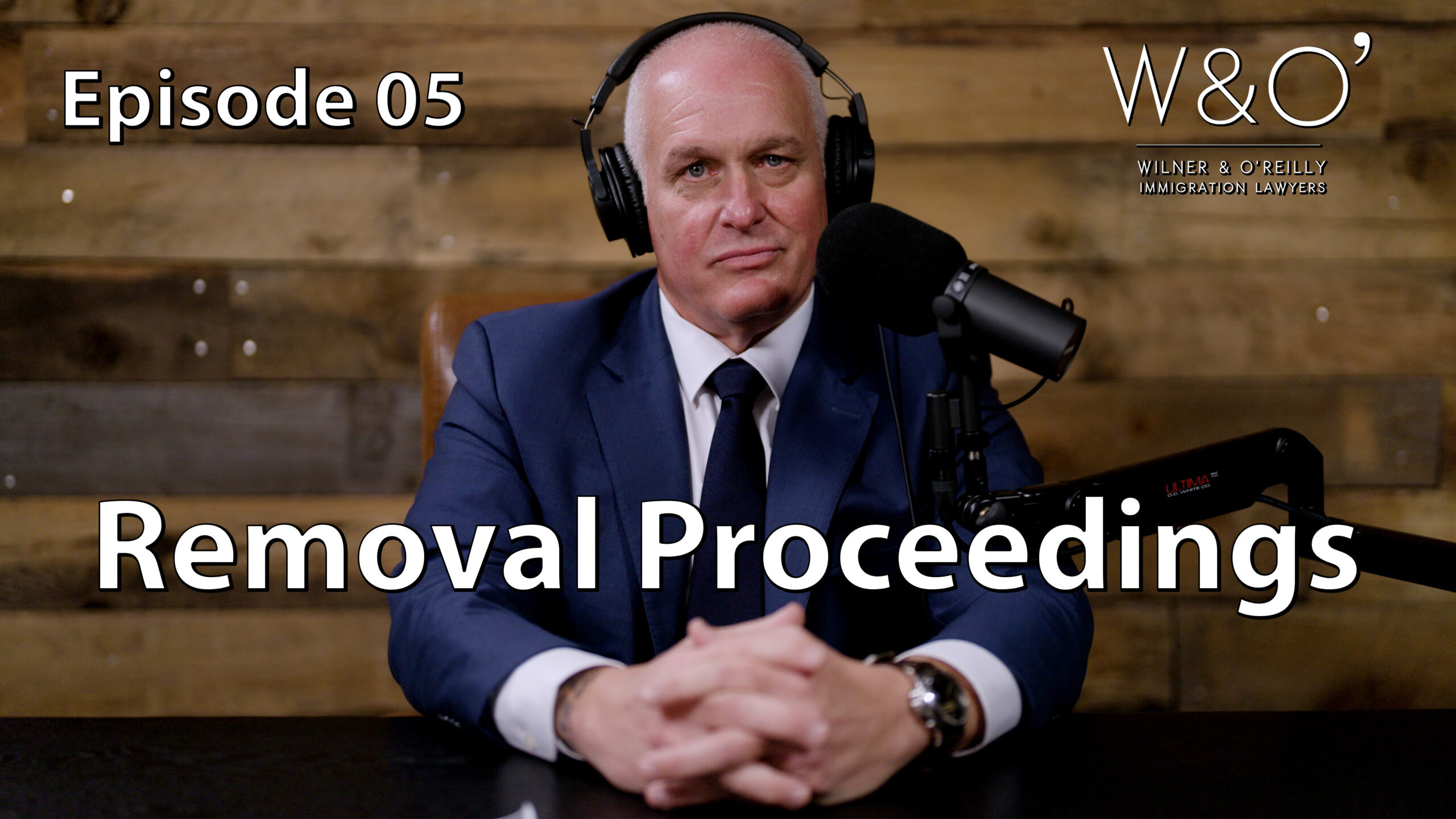
In Episode 5 of the ImmiGreat Podcast, Richard Wilner explains one of the most misunderstood areas of immigration law: removal proceedings.
As a Founding Shareholder of Wilner & O’Reilly and a Board-Certified Specialist in Immigration and Nationality Law, Richard breaks down what actually happens in immigration court and addresses a common misconception, being placed in removal proceedings does not automatically mean deportation .
What Are Removal Proceedings?
Removal proceedings are the legal process used by the U.S. government to determine whether a noncitizen should be removed (deported) from the United States.
While the process can be stressful and overwhelming, it is important to understand that there are often legal options available to remain in the U.S..
The process begins with a document called a Notice to Appear (NTA).
The Notice to Appear (NTA)
The Notice to Appear is the document that formally starts immigration court proceedings. It includes:
- Factual allegations about your background
- Your country of origin
- How and when you entered the United States
- Any prior immigration history
- The legal basis for removal (called the “charge of removability”)
The NTA also provides the date, time, and location of your first hearing.
It is critical that you attend this hearing.
Failure to appear can result in automatic removal, known as deportation in absentia.
What Happens at the First Hearing?
At your initial hearing (often called a master calendar hearing), the court will ask you to respond to the allegations in the Notice to Appear.
While immigration court is not a criminal proceeding, Richard compares this step to entering a plea in criminal court for simplicity.
At this stage, you will:
- Confirm or deny the factual allegations
- Address the charge of removability
- Inform the court of what type of relief you plan to pursue
If you need time to prepare or hire an attorney, the court will typically allow a continuance, especially at the first hearing.
What Is “Relief” From Removal?
Relief refers to the legal options available to remain in the United States despite being in removal proceedings.
Common forms of relief include:
- Adjustment of status (such as a green card through marriage)
- Asylum
- Cancellation of removal
- Other immigration benefits, depending on the case
After pleadings are entered, the case moves into the relief stage, where you formally pursue one or more of these options.
The Immigration Court Process
Removal proceedings often involve multiple hearings.
Today, many procedural hearings may be conducted remotely to improve efficiency. However, the most important hearing—the individual (or merits) hearing—typically requires your presence.
At the merits hearing:
- Evidence is presented
- Testimony may be given
- The judge evaluates your eligibility for relief
If relief is granted, removal proceedings are terminated, and you may receive lawful status in the United States.
Key Takeaways
Removal proceedings are serious, but they are not the end of the road.
Key points to remember:
- You must attend all scheduled hearings
- You have the opportunity to pursue legal relief
- Early preparation and legal guidance are critical
- Each case is highly fact-specific
As Richard emphasizes, understanding the process is the first step toward navigating it successfully.
Watch or Listen
Watch the full episode:
[YouTube link embedded on page]
For more information or to discuss your situation, contact Wilner & O’Reilly:
https://www.wilneroreilly.com/contact/
For additional insights, visit our Immigration Blog:
https://www.wilneroreilly.com/blog
About the ImmiGreat Podcast
The ImmiGreat Podcast, hosted by Richard Wilner, provides clear, practical guidance on complex immigration topics affecting individuals, families, and employers. Each episode is designed to help listeners better understand their options and make informed decisions.
Comments are closed.