


Wilner & O’Reilly has been alerted to reports of a sophisticated immigration bond scam targeting family members of people held in immigration detention.
Unlike many common fraud attempts, this scheme may involve documents designed to resemble official immigration court notices, references to real attorneys or organizations, virtual video proceedings, and individuals impersonating government officials or judges. The apparent objective is to convince a detainee’s family that a legitimate immigration bond has been ordered and that money must be transferred according to instructions supplied by the scammers.
Because the scheme appears designed to imitate parts of immigration detention and bond proceedings, families should be especially careful before transferring money in response to an unexpected bond request. If someone says a loved one can be released from immigration detention only if you immediately send money, independently verify the case, the purported hearing, and the payment instructions first.
How the Reported Immigration Bond Scam Works
Based on information provided to Wilner & O’Reilly, the reported scheme can involve several coordinated steps intended to make the fraud appear legitimate:
- A family member receives documents purporting to be official immigration court records, including what appears to be a bond hearing notice or documentation suggesting that legal proceedings were filed for the detained individual.
- The documents use the names of actual immigration attorneys or legitimate nonprofit organizations even though those people and organizations have no involvement in the case.
- The family is directed to participate in what appears to be a virtual immigration court hearing.
- During the virtual proceeding, an individual appears to be a judge or government official and says a bond payment is required to secure the detainee’s release.
- Banking, routing, or other payment instructions are then provided.
Each step adds another layer of apparent legitimacy. That is precisely what makes this type of scam so concerning.
Fake Immigration Court Documents Can Look Convincing
The redacted document provided to Wilner & O’Reilly illustrates how sophisticated the presentation can be. It purports to come from the U.S. Department of Justice’s Executive Office for Immigration Review (EOIR) and identifies an immigration court, a detention facility, and instructions for participating remotely.
To someone unfamiliar with immigration court paperwork, a document like this may initially appear official. However, the example also contains warning signs, including typographical errors, malformed government web addresses, unusual formatting, inconsistent terminology, and questionable procedural language.
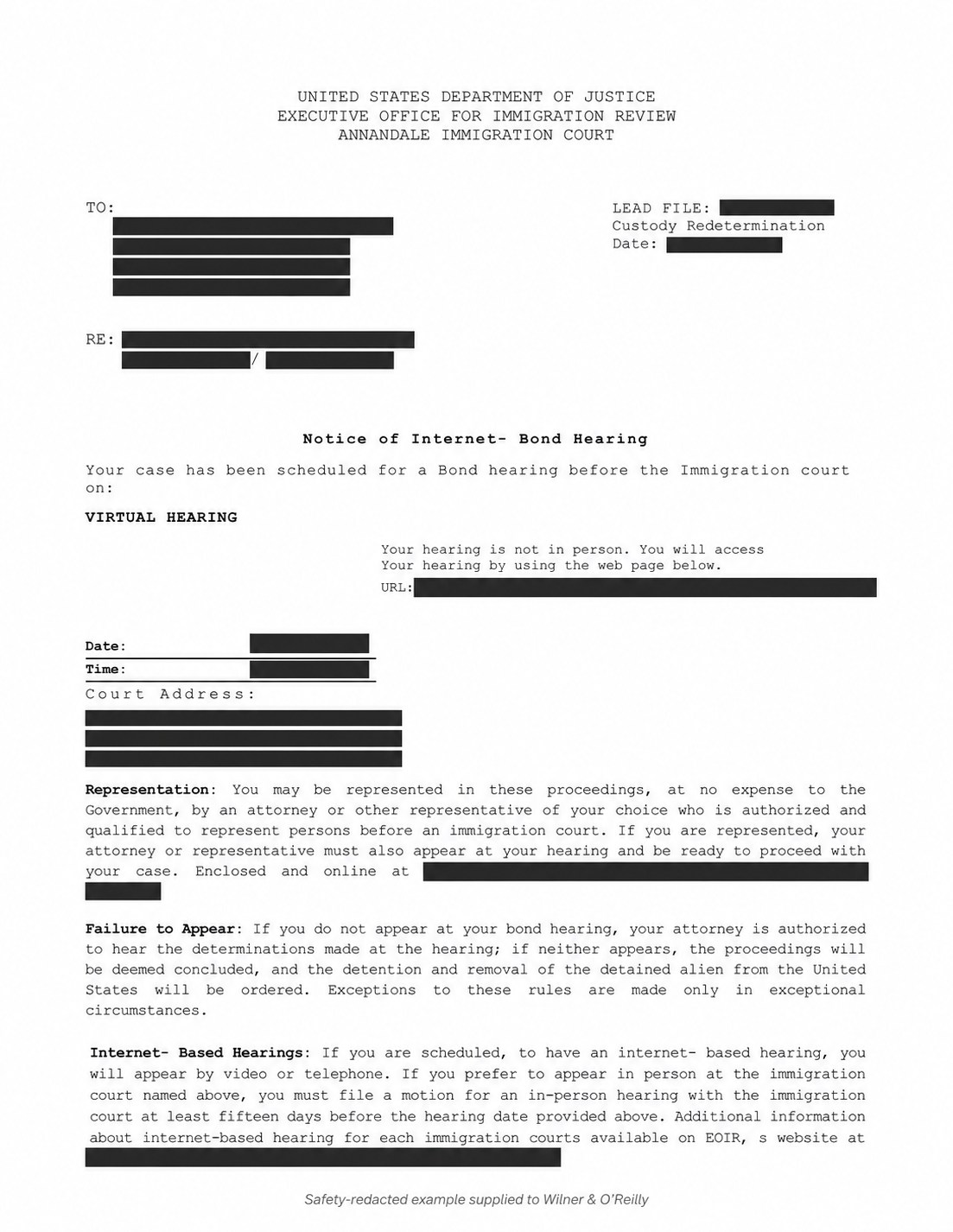
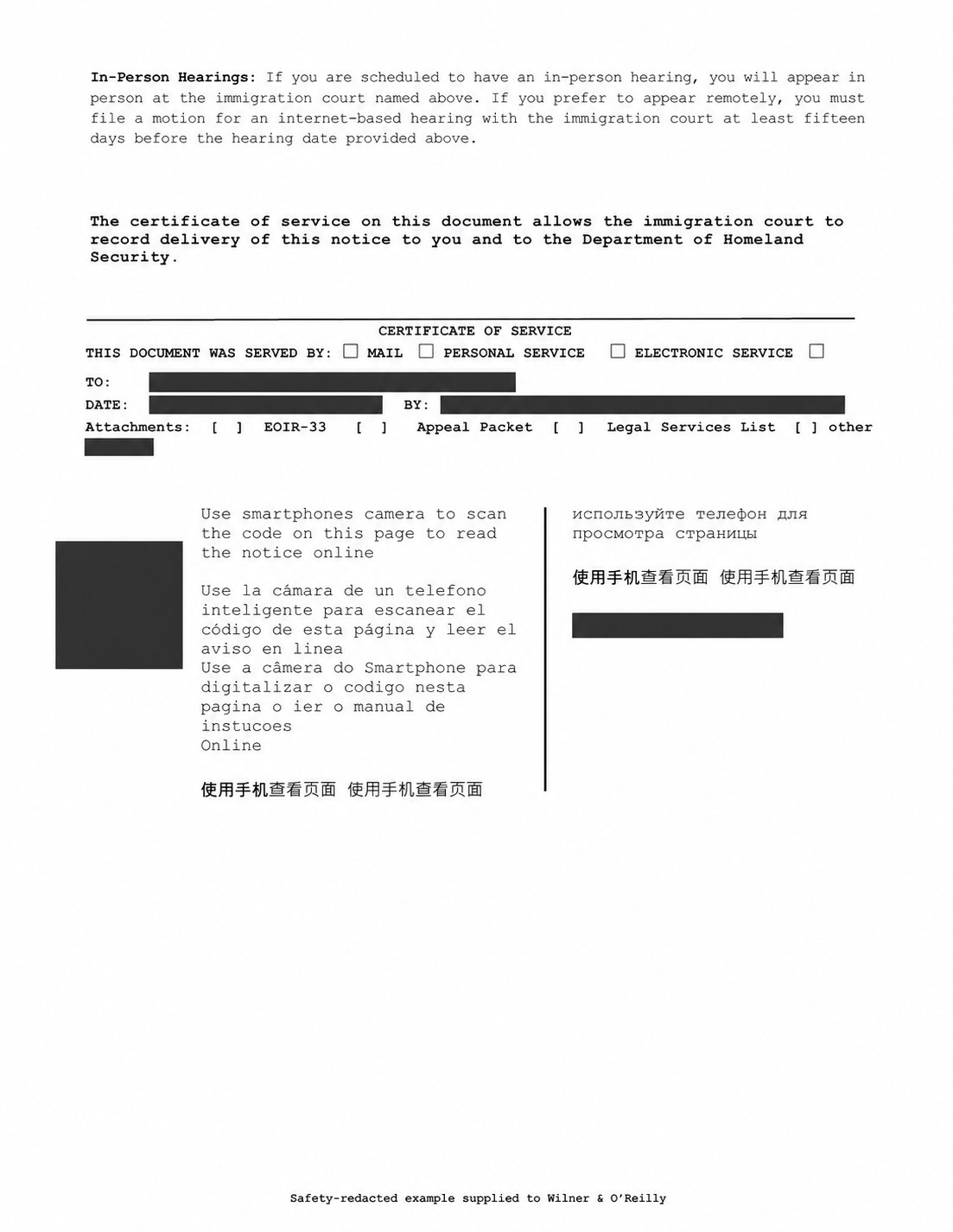
Example of a fraudulent immigration bond hearing notice provided to Wilner & O’Reilly. Identifying and potentially operative information has been removed.
The presence or absence of a typo alone should never be treated as definitive proof that a document is fraudulent. Sophisticated scammers can reproduce government branding and publicly available information with increasing accuracy. Independent verification is the safer approach.
How to Verify a Purported Immigration Court Hearing
If you receive an unexpected hearing notice involving someone in immigration proceedings, verify the information independently. Do not begin with links, telephone numbers, QR codes, or contact information contained only in the suspicious communication.
- Check the official EOIR system. EOIR’s Automated Case Information system can provide certain case-status information. EOIR cautions that the system does not display bond-hearing information.
- Contact the immigration court directly about a bond hearing. Use the court contact information on the official Department of Justice page for immigration courts and internet-based hearings. Do not call a number supplied only in the questionable document.
- Compare the notice with official information. EOIR explains that court documents are the official source of case information and advises people to contact the court when clarification is needed. Review EOIR’s case-information guidance.
- Contact known counsel directly. If the detained person has an attorney, use a telephone number or email address you already know or independently verify.
Real EOIR hearings may be conducted over Webex, so the use of a video platform by itself does not prove fraud. The hearing, link, court, and payment request should all be independently confirmed through official channels.
Scammers May Impersonate Real Attorneys and Organizations
One particularly concerning aspect of the reported scam is the alleged use of names belonging to real attorneys and legitimate nonprofit organizations. Seeing a recognizable law firm, attorney, nonprofit organization, court, or government agency on a document does not establish that the communication is genuine.
If a document claims that an attorney represents your loved one:
- Find the attorney or organization’s legitimate contact information independently.
- Contact the attorney directly.
- Ask whether the attorney represents the detained person.
- Confirm whether that attorney filed the document referenced in the communication.
- Confirm whether a legitimate bond hearing has occurred or is scheduled.
Do not rely exclusively on a telephone number, email address, link, or QR code supplied in the document you are trying to authenticate.
How to Verify an Immigration Bond Payment Request
Immigration detention and bond procedures can be confusing, which makes families particularly vulnerable to people pretending to understand the system. A legitimate bond matter may involve ICE and, depending on the circumstances, an immigration judge. Families should not assume that an unexpected request for money is legitimate simply because the caller knows details about the detained person or presents official-looking documents.
ICE states that bonds for detained individuals may be posted at ERO bond-acceptance offices and provides current bond information through its Attorney Information and Resources page. ICE also operates the official CeBONDS system. Verify the current procedure directly through official government resources before transferring funds because procedures can change.
For an overview of detention, bond eligibility, and release, read ImmiGreat Podcast Episode 6: ICE Detention & Immigration Bonds and Wilner & O’Reilly’s guide to immigration bond eligibility.
Immigration Bond Scam Red Flags
No single warning sign proves fraud. Slow down and independently verify a request when you encounter circumstances such as:
- Unexpected instructions to transfer money immediately
- Pressure suggesting that release depends on paying within a very short period
- Banking or routing instructions provided during an unexpected virtual proceeding
- An attorney you have never retained appearing on purported legal paperwork
- Instructions not to contact other attorneys, the court, ICE, or family members
- Government documents containing unusual errors or questionable URLs
- Requests to use payment methods that do not match current official government procedures
- A virtual hearing that cannot be independently confirmed through official sources
The sophistication of the reported scheme means families should not depend exclusively on whether something “looks real.”
What to Do If You May Have Been Targeted
If you believe you may have been targeted by an immigration bond scam, act promptly. Preserve:
- Emails and text messages
- Hearing notices and screenshots
- Video-meeting information and telephone numbers
- Payment instructions and receipts
- Bank records
- Names used by the individuals involved
Contact your bank or financial institution as quickly as possible to ask whether a transfer can be stopped, recalled, or investigated. The Federal Trade Commission advises consumers to act quickly after a fraudulent payment and provides reporting through ReportFraud.ftc.gov. The FTC also explains how to recognize and respond to government impersonation scams.
If someone impersonated a federal employee, immigration official, attorney, or judge, preserve the evidence before deleting or blocking communications.
Verify Before You Pay
When someone is detained by immigration authorities, families are often frightened and searching for any legitimate way to bring their loved one home. Scammers understand that urgency. They may know that families are unfamiliar with immigration court terminology, detention procedures, bonds, habeas proceedings, or the roles of ICE, DHS, EOIR, and federal courts.
Taking additional time to verify a request is not interfering with your loved one’s case. It is a reasonable precaution when money and someone’s immigration situation are involved.
The most important takeaway is straightforward: verify before you pay.
If a purported judge, attorney, government official, or other person tells you that money must be transferred to release someone from immigration detention, independently confirm the request. Use official government websites. Contact the attorney directly. Verify the hearing independently. When there is uncertainty, speak with experienced immigration counsel before transferring money.
Wilner & O’Reilly is sharing this alert because the reported scam demonstrates a level of sophistication that could make it difficult for families unfamiliar with immigration proceedings to recognize the fraud. We encourage immigration attorneys, community organizations, and families with loved ones in detention to make others aware of these reported tactics.
Families facing detention may also benefit from understanding their options in removal proceedings and deportation defense.
Frequently Asked Questions About Immigration Bond Scams
Is this immigration bond scam real?
Wilner & O’Reilly has been alerted to reports of a sophisticated scheme targeting families of immigration detainees with purported court documents, virtual hearings, and fraudulent bond-payment instructions. The firm is sharing the warning so families can recognize the reported tactics and verify requests independently.
Can a fake immigration court notice include a virtual-hearing link?
Yes. The example provided to Wilner & O’Reilly was designed to resemble an EOIR immigration court document and included a purported virtual-hearing link. Real EOIR proceedings can also use Webex, so families should confirm the specific hearing and link directly with the court.
Can scammers impersonate an immigration judge?
The reported scheme involves individuals allegedly presenting themselves during virtual proceedings in a manner intended to resemble an official immigration hearing. Independently verify any unexpected proceeding before sending money.
How can I verify an immigration court hearing?
Use EOIR’s official Automated Case Information system for the case information it provides. Because EOIR says that bond-hearing information is not available through that system, contact the appropriate immigration court using independently obtained information from the official Department of Justice website.
What if an attorney or organization is named on the document?
Contact the attorney or organization independently using verified contact information. Do not rely solely on a telephone number, email address, link, or QR code contained in the questionable document.
How are legitimate immigration bonds paid?
ICE publishes current information about bond acceptance and operates CeBONDS. Because procedures can change, verify the current instructions through official ICE resources before transferring funds or following payment directions.
What should I do if someone pressures me to pay immediately?
Do not allow urgency alone to determine your decision. Independently verify the hearing, case, person requesting payment, and payment method before transferring money.
What should I do if I already sent money?
Preserve all communications and payment records, contact your financial institution promptly, and report suspected fraud through the FTC. Consider consulting an attorney about additional steps based on the circumstances.
Questions About Detention, Bond, or a Suspicious Communication?
If your loved one is being held in immigration detention and you have questions about bond proceedings, release options, or communications you received about the case, Wilner & O’Reilly can help you understand the process.
Contact Wilner & O’Reilly to discuss your situation, or read additional immigration updates.
Comments are closed.