

Legal update: October 19, 2026. This article provides general information, not advice about an individual case. Rules, agency practices, and court decisions can change.
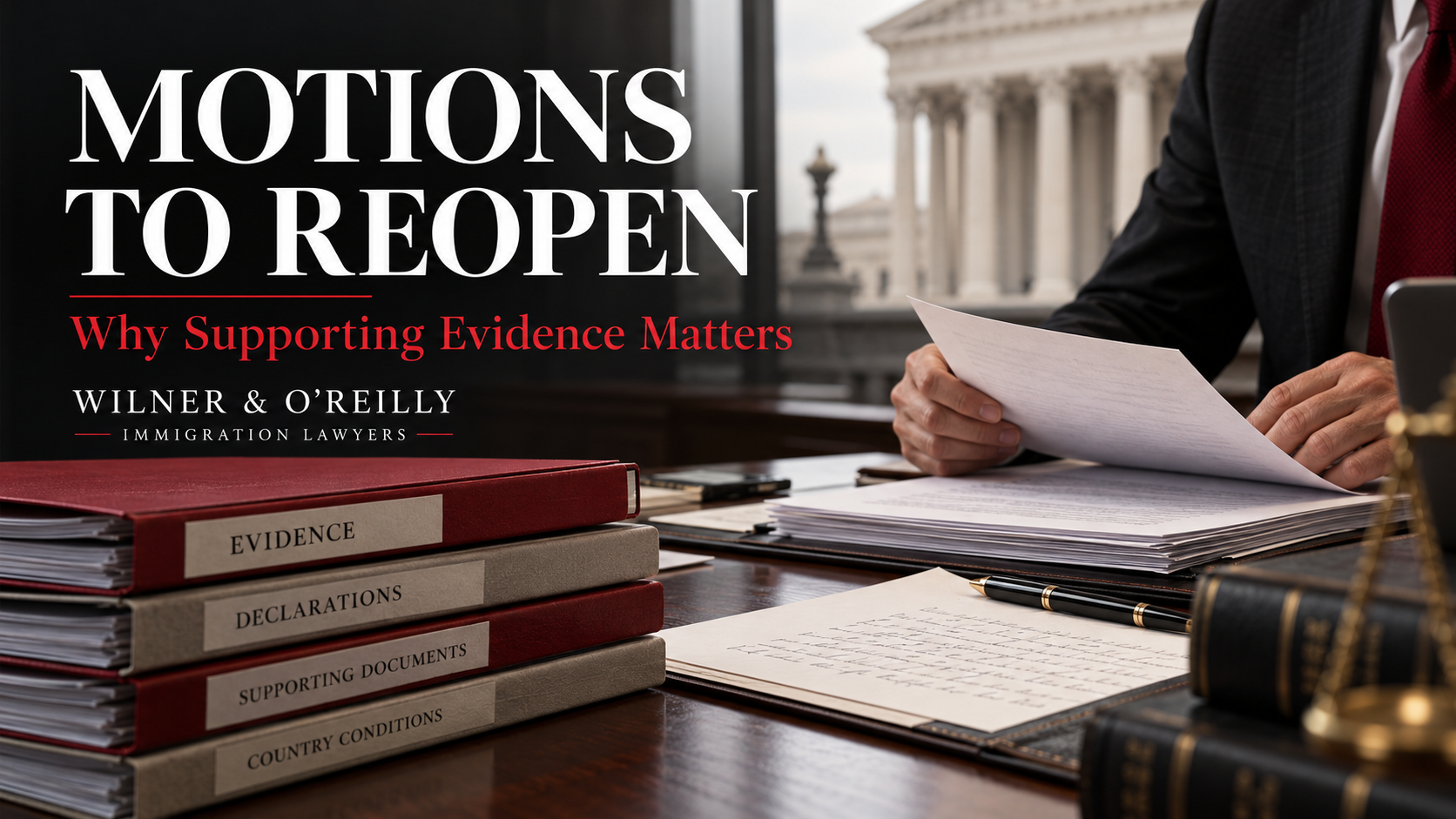
A signed declaration does not guarantee that an immigration court will accept its account as true. In Matter of J-E-D-C-, 30 I&N Dec. 162 (BIA 2026), decided October 19, 2026, the Board of Immigration Appeals addressed how immigration judges and the Board evaluate written factual statements supporting motions to reopen. For people trying to reopen a removal case, the practical lesson is to build a complete, consistent evidentiary record.
What Did the BIA Decide?
The Board held that judges and the BIA are not required to accept a respondent’s factual statements in an affidavit, declaration, or other written statement as true merely because those statements are not inherently unbelievable. It reasoned that Supreme Court precedent permits the agency to evaluate reliability, persuasiveness, and whether the person has met the burden for reopening. The decision does not make corroborating documents mandatory in every case or mean that a declaration cannot establish relevant facts. Rather, the Board emphasizes evaluating the evidence and determining whether the applicant has met the applicable burden.
The case involved a respondent seeking to reopen an in absentia removal order after missing a hearing. He asserted that he believed he would receive another hearing notice. However, the record reflected that DHS had personally served him with a notice containing the hearing date, time, and location, and that the information had been explained in Spanish. The BIA found his explanation inconsistent with the record and concluded that he had not established exceptional circumstances warranting reopening.
Why the Ninth Circuit Issue Matters
The Ninth Circuit issue matters. In Matter of J-E-D-C-, the BIA expressly disagreed with Ninth Circuit precedent requiring the agency generally to accept factual statements supporting a motion to reopen unless they are inherently unbelievable. The Board reasoned that this approach conflicts with INS v. Abudu and Garland v. Ming Dai. However, the Ninth Circuit has recently reaffirmed its approach, including in Trigueros Quizar v. Blanche and Wei v. Blanche. The BIA’s decision does not itself overrule those federal appellate decisions. Counsel should evaluate controlling circuit law and preserve appropriate challenges when the agency applies a conflicting standard.
What Is a Motion to Reopen?
A motion to reopen asks the immigration judge or BIA to revisit a completed case so that new facts or evidence can be considered. The motion must identify the facts to be proved and include supporting evidence. A motion to reconsider is different: it ordinarily challenges legal or factual errors on the existing record.
Under EOIR’s guidance on post-decision motions, material evidence that was unavailable and could not have been discovered or presented earlier is generally required. Different requirements apply depending on the basis for reopening. For example, motions to rescind an in absentia order based on exceptional circumstances or lack of notice are governed by specific statutory provisions, rather than simply the ordinary new-evidence standard. The correct filing body, deadline, number limits, and any exception depend on the case.
Build Evidence Around the Specific Reason for Reopening
| Evidence to organize | Why it may help |
|---|---|
| A detailed personal declaration | Explain dates, events, what you understood, and how you learned of the problem. Address conflicting information honestly. |
| Hearing notices, envelopes, and address records | Help establish what was sent, where it was sent, and which address updates were made. |
| Contemporaneous records | Medical records, travel records, messages, or other documents may support the particular explanation. Their relevance depends on the facts. |
| Statements from people with direct knowledge | Explain what the witness personally observed and how the witness knows it. |
| A consistent chronology and complete prior filings | Allow counsel to identify gaps and explain differences between the motion and the existing record. |
More paper is not always better. The goal is relevant, reliable evidence that connects the legal ground for reopening to what actually happened. Never alter records or sign a declaration that contains guesses presented as facts.
Deadlines Still Matter
The new decision does not create extra time to file. EOIR’s deadline chart lists a general 90-day reopening deadline, with exceptions. A motion to rescind an in absentia removal order based on exceptional circumstances generally has a 180-day deadline; lack-of-notice claims follow different rules. Other exceptions or tolling arguments require individual analysis.
Filing an ordinary motion to reopen generally does not automatically stop removal. However, the statute provides an automatic stay of removal while an immigration judge considers certain motions to rescind an in absentia order. Counsel should determine whether that provision applies or whether a separate stay request is necessary.
What to Do Now
- Obtain the order, hearing notices, prior filings, and proof of service or address changes.
- Write a dated timeline while events are still fresh.
- Collect relevant supporting records and identify direct-knowledge witnesses.
- Have counsel assess deadlines, the applicable circuit law, and the legal ground for reopening.
For related notice issues, read our guide to immigration address changes after Matter of Diji.
Frequently Asked Questions
Is my declaration still useful?
Yes. A detailed, truthful declaration remains important, but the agency may assess it alongside the rest of the record. Relevant corroborating documents can strengthen the factual presentation.
Does this decision mean motions to reopen cannot succeed?
No. It concerns how supporting evidence is evaluated. A motion still depends on its legal basis, evidence, deadlines, and the law that governs the case.
Should I wait until I have every document before contacting an attorney?
No. Contact counsel promptly so deadlines and any urgent stay issues can be assessed while supporting evidence is gathered.
Talk With Wilner & O’Reilly
Our immigration attorneys can review your documents, deadlines, and available options. Contact Wilner & O’Reilly to request a consultation.
Comments are closed.