

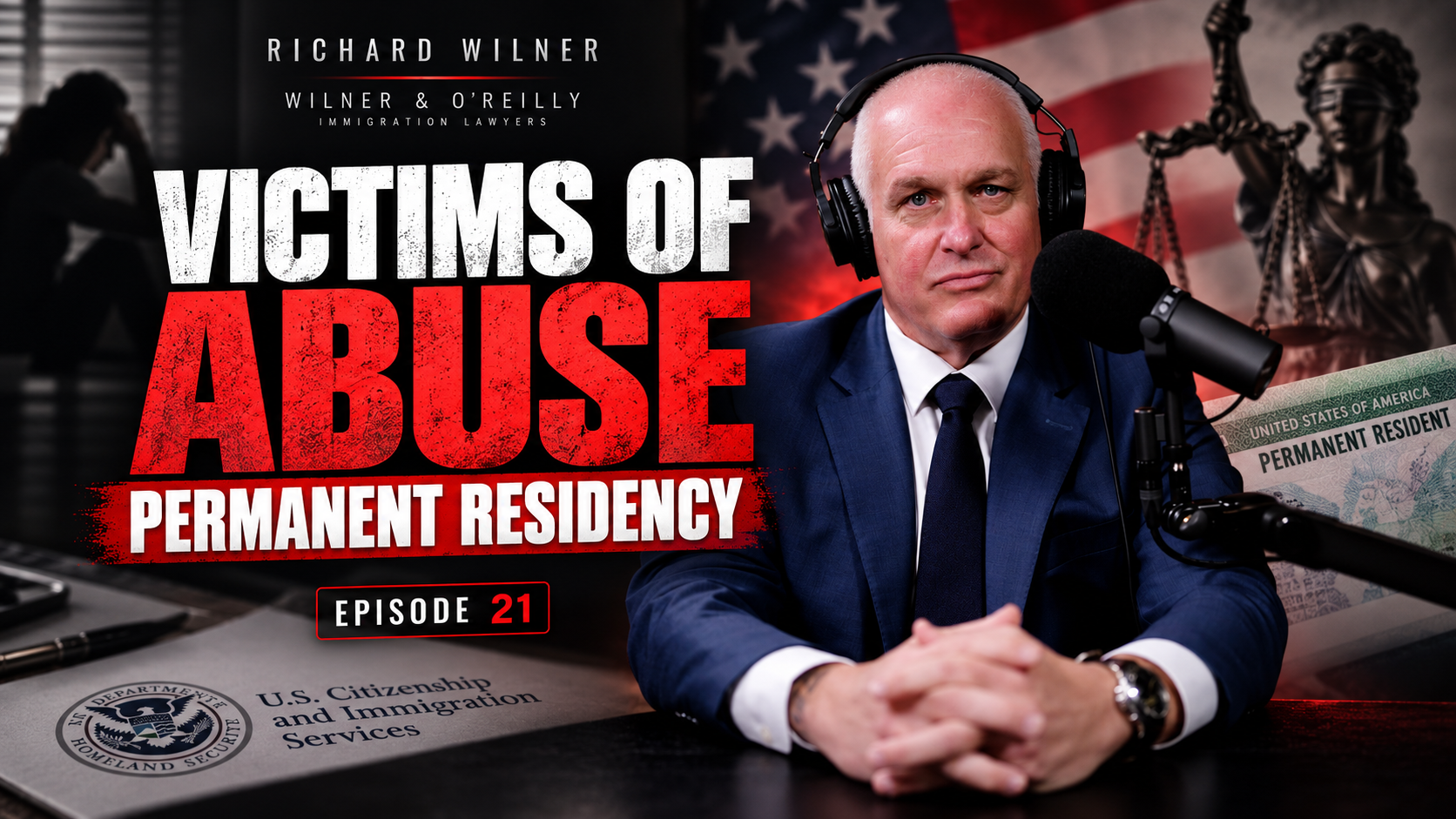
In Episode 21 of the ImmiGreat Podcast, Richard Wilner discusses immigration options for abuse survivors who fear that leaving a relationship will cost them their future in the United States. He explains four distinct avenues: a VAWA self-petition, an I-751 abuse waiver, special rule cancellation of removal, and U nonimmigrant status.
The episode’s central message is that an abusive spouse’s cooperation is not always necessary to pursue immigration relief. The right option depends on the survivor’s relationship, immigration history, evidence, and whether the case is before USCIS or an immigration judge.
This article is for general educational purposes and is not legal advice. Eligibility, deadlines, confidentiality protections, and available benefits depend on the facts of each case.
1. VAWA Self-Petitions: Applying Without an Abusive Spouse’s Cooperation
The Violence Against Women Act, commonly called VAWA, allows certain survivors to file Form I-360 for themselves instead of relying on an abusive family member to petition for them. Despite the law’s name, eligible men can also qualify. This episode focuses on spouses of U.S. citizens and lawful permanent residents; separate provisions address certain abused children and parents.
A spousal self-petition generally requires a qualifying relationship, a marriage entered into in good faith, battery or extreme cruelty during the relationship, shared residence, and good moral character. Physical injury is not the only possible form of qualifying abuse, but whether conduct meets the legal standard requires a careful review of the circumstances.
Divorce does not necessarily end eligibility. When a divorce occurs before filing, the self-petition generally must be filed within two years of the legal termination of the marriage, with evidence connecting that termination to the battery or extreme cruelty. USCIS explains the VAWA eligibility requirements and how divorce affects a self-petition.
2. I-751 Abuse Waivers: Removing Conditions on Residence
A different issue arises when someone already has a two-year conditional green card based on marriage. Ordinarily, the couple files Form I-751 jointly to remove the conditions. An eligible survivor may instead request a waiver of the joint filing requirement based on battery or extreme cruelty.
This waiver can allow a conditional resident who entered the marriage in good faith to proceed without the petitioning spouse’s signature. Divorce is not required for the abuse-based waiver. Extreme hardship is a separate possible waiver basis; it is not an additional requirement for every abuse waiver.
Timing also differs from an ordinary joint filing. USCIS permits eligible waiver requests before, during, or after the usual 90-day filing window. That flexibility is not a reason to ignore an expiring card, a USCIS notice, or a court deadline. Review the USCIS guidance on I-751 waivers with counsel to identify the appropriate filing basis and timing.
3. Special Rule Cancellation of Removal: Relief in Immigration Court
Survivors already in removal proceedings may have another avenue to explore with an attorney: special rule cancellation of removal for certain battered spouses and children. This is a form of relief decided by an immigration judge, rather than a substitute name for a VAWA self-petition.
The requirements generally include a qualifying abusive relationship involving a U.S. citizen or permanent resident, at least three years of continuous physical presence, good moral character, and extreme hardship to the applicant, a child, or a parent if the applicant is removed. Criminal history and other statutory restrictions also matter. Meeting a single requirement does not establish eligibility.
An approval can result in lawful permanent residence, but relief is discretionary and requires evidence. The Department of Justice provides an overview of special rule cancellation for survivors of battery or extreme cruelty. Anyone with an immigration court hearing should address the court case and its deadlines promptly.
4. U Visas: A Separate Option for Victims of Qualifying Crimes
U nonimmigrant status may be available to victims of certain qualifying crimes, including domestic violence, who suffered substantial physical or mental abuse and meet the other requirements. A U visa does not require marriage to the offender, and the offender does not have to be undocumented. The offender’s immigration status does not determine whether the crime can qualify.
A central requirement is Form I-918, Supplement B, signed by an authorized certifying official. It documents the qualifying criminal activity and the victim’s past, present, or likely helpfulness to the appropriate authorities. A police report alone is not a substitute for this certification, and a signed certification does not itself grant immigration status.
USCIS confirms that certification can be provided even when there has been no arrest, prosecution, or conviction. Survivors should discuss the certification process and any requests for assistance with counsel rather than assume that a closed case automatically ends their options. See USCIS information for U visa certifying officials.
Why Evidence, Timing, and Safe Communication Matter
Richard emphasizes that survivors should understand their options before assuming they must remain in an abusive relationship. Each pathway has its own legal requirements and evidence rules. An attorney can review marriage and immigration records, relevant communications, and available supporting documentation without assuming that every survivor has the same records.
VAWA-related cases have special confidentiality protections, but survivors should still plan a safe mailing address and communication method. Filing alone does not automatically grant a green card, a work permit, or protection from every immigration consequence. Advice should account for the person’s full immigration and court history.
Frequently Asked Questions
Can men qualify for VAWA immigration relief?
Yes. VAWA immigration protections are available to eligible survivors regardless of gender. The qualifying relationship, abuse, and other requirements still must be established.
Do I need my abusive spouse’s permission to file a VAWA self-petition?
No. A qualifying survivor can self-petition without the abusive spouse’s signature or cooperation. USCIS applies special confidentiality protections, and an attorney can help plan safe correspondence.
Does a U visa require an arrest or conviction?
No. A qualifying certifying agency can provide the required certification even if there has been no arrest, prosecution, or conviction. The survivor must still meet the U visa requirements, including the applicable helpfulness requirement.
Does filing an application automatically give me a green card or work permit?
No. Filing alone does not automatically grant permanent residence or employment authorization. The available benefits depend on the type of case, eligibility, and the stage of adjudication.
Key Takeaways
- VAWA self-petitions, I-751 waivers, cancellation of removal, and U visas are distinct forms of relief.
- An abusive spouse’s refusal to cooperate does not necessarily prevent a survivor from pursuing a case.
- Divorce, conditional residence, and immigration court proceedings can change the filing strategy and deadlines.
- U visa certification is required, but an arrest or conviction is not.
- A careful review of eligibility and evidence is essential; no outcome is automatic.
Watch or Listen to ImmiGreat Episode 21
Watch Richard Wilner explain these four immigration options in the video above, or listen to the full episode below.
Listen to or download the Episode 21 audio.
Related Wilner & O’Reilly Resources
- Asylum and humanitarian relief articles
- Deportation and removal defense articles
- More ImmiGreat Podcast episodes
Discuss Your Immigration Options With Wilner & O’Reilly
If abuse, divorce, conditional residence, or a pending immigration court case is affecting your plans, contact Wilner & O’Reilly to discuss your circumstances and potential options. Let the team know how and when it is safe to contact you.
About the ImmiGreat Podcast
Hosted by Richard Wilner, the ImmiGreat Podcast explores immigration law and the real situations individuals and families face. Episode 21 explains why abuse survivors may have immigration options beyond a case controlled by an abusive spouse.
Comments are closed.