

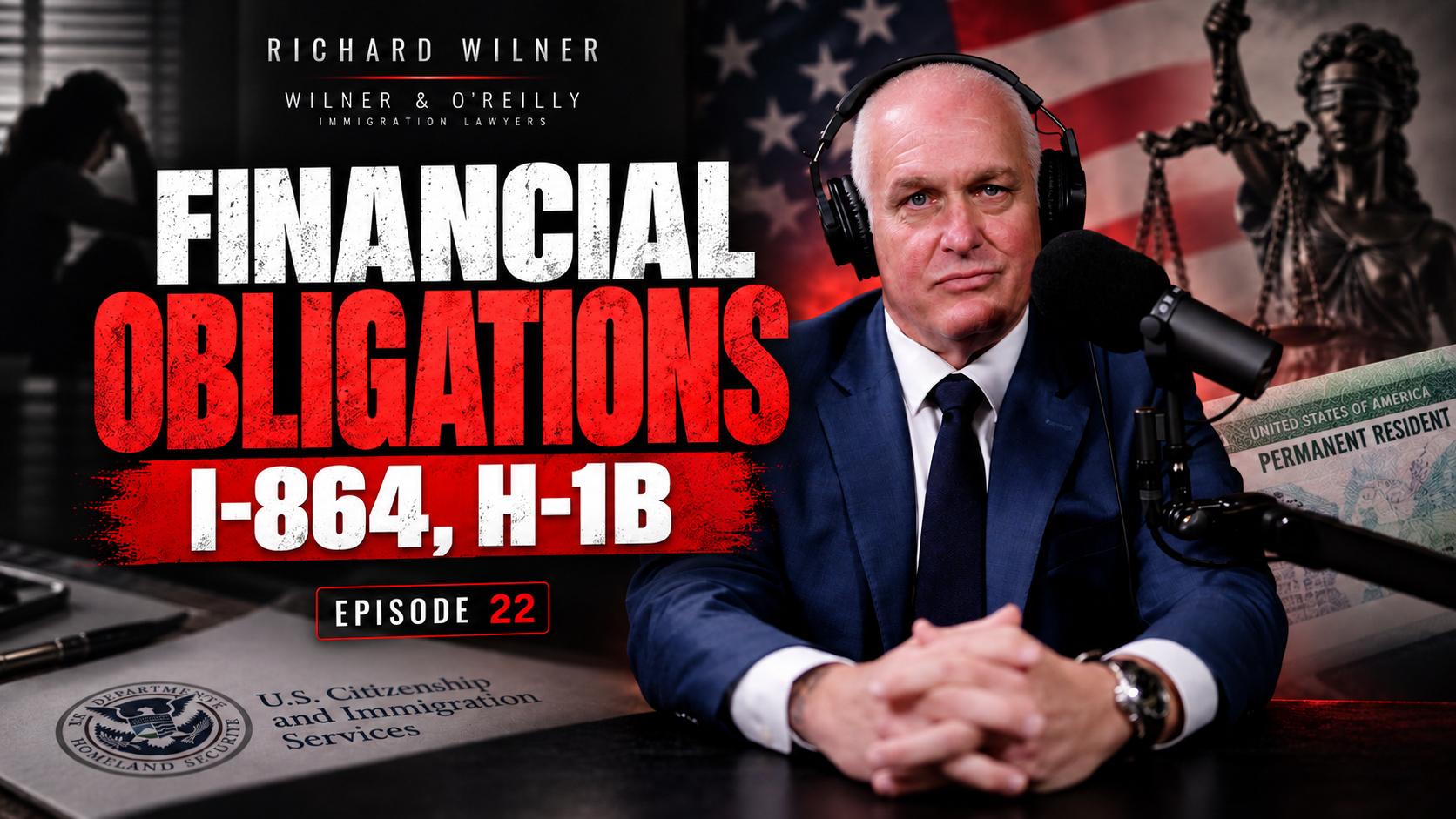
Immigration obligations can create financial exposure long before anyone faces removal proceedings. In Episode 22 of the ImmiGreat Podcast, Richard Wilner explains two risks that sponsors, employers, and workers may overlook: enforcing the Form I-864 Affidavit of Support and addressing H-1B job or wage violations.
One risk can affect a sponsor’s bank account after a marriage ends. The other can arise when an H-1B employer’s payroll or actual job assignments do not match its immigration commitments. Understanding the documents you sign—and the work you are actually required to perform—is the starting point.
This article summarizes Episode 22 and provides general educational information. Immigration, support, and employment disputes require advice based on the particular facts.
Risk One: I-864 Sponsorship Can Become a Financial Dispute
Form I-864 is a legally enforceable support contract, rather than a routine immigration form with no consequences after approval. As Richard explains, signing it can create obligations to both the sponsored immigrant and the government.
The sponsor generally commits to provide support needed to maintain the sponsored immigrant at 125 percent of the applicable Federal Poverty Guidelines. A limited 100 percent exception applies to certain active-duty military petitioning sponsors. Government agencies may also seek reimbursement for covered means-tested public benefits. The immigrant’s income, the applicable threshold, the signed documents, and any terminating event matter when evaluating a claim.
A joint sponsor should take the commitment seriously, too. Helping someone meet an immigration application’s financial requirement can create enforceable obligations under the joint sponsor’s own affidavit. Review the USCIS Form I-864 contract before signing.
Divorce Does Not Automatically End the Support Obligation
A central lesson of Episode 22 is that divorce does not terminate I-864 liability. A former spouse may pursue enforcement even after the family-law case is over. Richard also cautions sponsors against assuming that a prenuptial agreement eliminates their federal support commitment.
Do not treat a divorce settlement or private agreement as a substitute for reviewing the affidavit and the law governing its enforcement. If you receive a demand or lawsuit, preserve the signed forms, immigration records, financial information, and court papers, and obtain advice before a response deadline passes.
For more detail, explore Wilner & O’Reilly’s I-864 litigation defense services and ImmiGreat Episode 19 on liability after divorce.
Risk Two: H-1B Job Duties and Pay Must Match the Commitments
Richard’s second example involves an employee petitioned for a professional position, such as an accountant, who is instead required to perform unrelated household chores for the employer. An H-1B petition is tied to qualifying employment; an employer cannot treat the approval as permission to assign any job it chooses.
Material differences between the petitioned role and actual duties can raise immigration compliance concerns. Workers and employers should review proposed changes in duties, worksite, or other employment terms before implementing them.
Pay is another key issue. According to the Department of Labor’s H-1B worker guidance, the required wage is generally the higher of the employer’s actual wage for comparable employees or the prevailing wage for the occupation and location. Workers should receive a copy of the Labor Condition Application (LCA), which documents important employer commitments.
How H-1B Workers Can Raise Wage Concerns
The Department of Labor’s Wage and Hour Division investigates alleged H-1B violations. Workers can use Form WH-4 and its instructions to report concerns to the appropriate office. Depending on the findings, enforcement may include back wages and other remedies or penalties; these are not automatic results of filing a complaint.
In the episode, Richard explains that immigration issues may overlap with federal or state wage-and-hour claims. Wilner & O’Reilly may coordinate with outside labor and employment counsel when a matter requires that expertise.
- Keep employment documents: Preserve the offer letter, LCA, available petition records, and descriptions of the promised duties and pay.
- Record what happened: Save pay statements, work schedules, time records, and messages about assignments or compensation.
- Discuss both tracks: Review potential wage remedies alongside immigration status, work authorization, and any proposed job change.
- Raise concerns promptly: Complaint deadlines and other legal time limits can affect available options.
Retaliation Protections and Immigration Options Are Separate Questions
H-1B rules prohibit employers from retaliating against workers for protected reports or cooperation with investigations. Those protections are important, but a wage complaint does not automatically grant lawful status or work authorization. Obtain individual advice before resigning, changing employers, or making other decisions that may affect an immigration case.
Richard also discusses possible U visa relief in workplace abuse cases. An ordinary pay dispute does not, by itself, establish U visa eligibility. The Department of Labor’s U and T visa guidance addresses qualifying criminal activity, cooperation with authorities, and the certification process. An attorney should evaluate those requirements and any other potential options based on the facts.
Frequently Asked Questions
Does divorce cancel an I-864 Affidavit of Support?
No. Divorce alone does not end the obligation. The affidavit’s terms, any legally recognized terminating event, and the facts of the support claim must be reviewed.
Can a joint sponsor face an I-864 claim?
Yes. A joint sponsor signs an enforceable affidavit and should understand the resulting financial commitment before agreeing to sponsor.
What if an H-1B employer does not pay the required wage?
Preserve the LCA, pay records, and related communications. The Department of Labor’s Wage and Hour Division handles alleged H-1B violations, and counsel can help evaluate overlapping employment and immigration issues.
Does reporting workplace abuse automatically qualify someone for a U visa?
No. U visa eligibility requires qualifying criminal activity and other legal requirements. A wage complaint and an immigration application are separate processes.
Watch or Listen to ImmiGreat Episode 22
Watch Richard Wilner’s discussion above or listen to The 2 Immigration Risks Nobody Warns Sponsors & H-1B Workers About below.
Watch Episode 22 on YouTube or visit the episode on Buzzsprout.
Talk With Wilner & O’Reilly About Your Situation
If you are facing an I-864 demand, an H-1B wage dispute, or concerns about your actual job duties, contact Wilner & O’Reilly to discuss your circumstances. For more practical immigration conversations, browse the ImmiGreat Podcast articles.
About the ImmiGreat Podcast
Hosted by Richard Wilner, the ImmiGreat Podcast explores immigration law and the real-life decisions facing immigrants, families, sponsors, and employers. Episode 22 highlights why financial sponsorship and employment commitments deserve careful attention.
Comments are closed.