

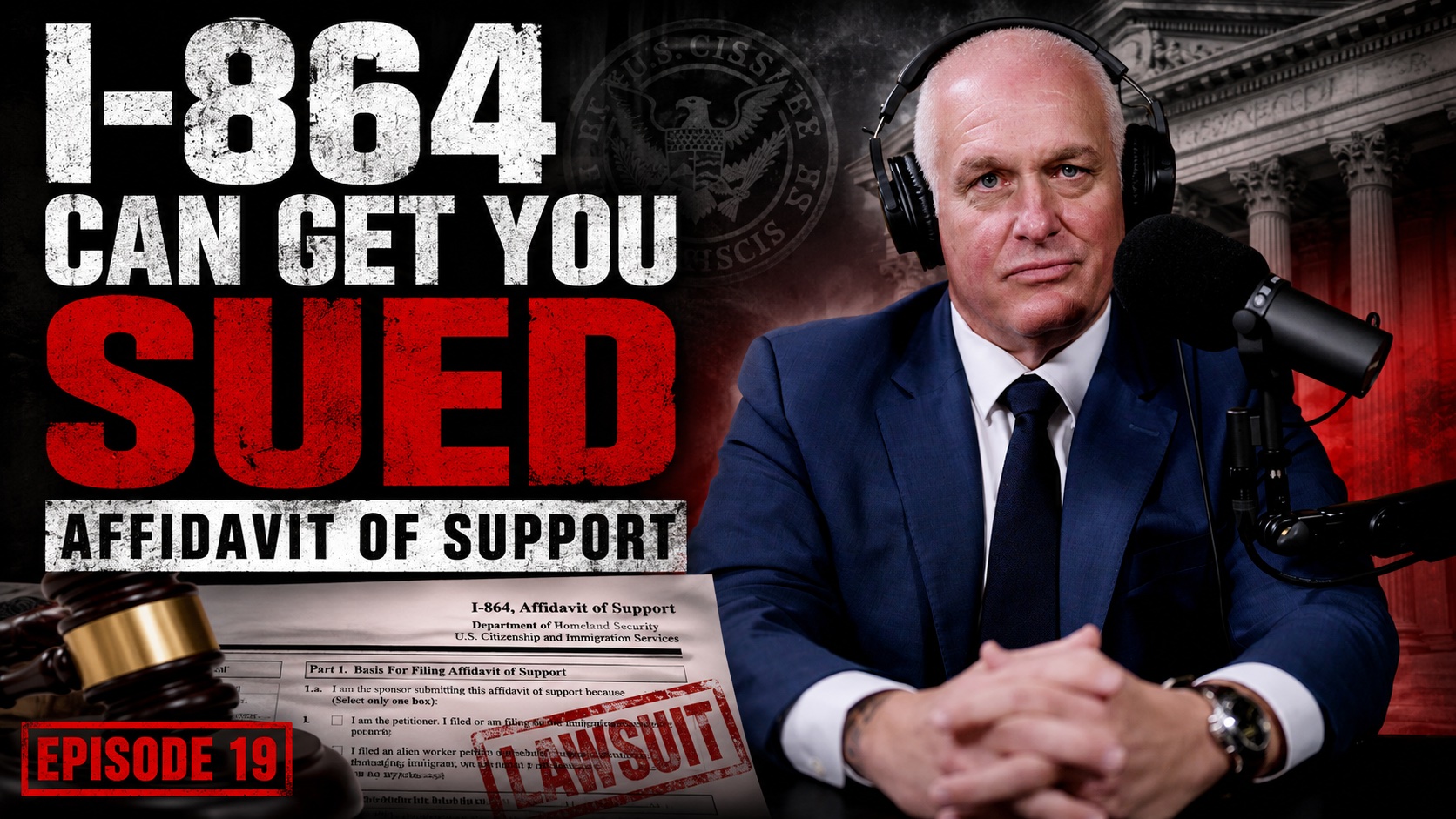
In Episode 19 of the ImmiGreat Podcast, Richard Wilner explains why signing Form I-864, Affidavit of Support, can create a financial obligation that continues long after a marriage ends.
The episode addresses a problem many sponsors do not anticipate: a former spouse who became a lawful permanent resident may be able to enforce the I-864 support contract even after divorce. A divorce decree, prenuptial agreement, or family-court support order does not necessarily eliminate the separate federal obligation created when the sponsor signed the form.
Richard explains what the contract requires, who may enforce it, how a sponsored immigrant’s earnings can affect a claim, and why anyone who receives an I-864 demand letter or lawsuit should take it seriously from the beginning.
Form I-864 Is a Legally Enforceable Contract
Form I-864 is not simply a statement of good intentions. It is a contract between the sponsor and the U.S. government that is submitted for many family-based immigrants and certain employment-based immigrants.
By signing the form, the sponsor generally agrees to use available resources to maintain the sponsored immigrant at no less than 125% of the federal poverty guideline while the obligation remains in effect. The contract may also create responsibility for reimbursing a government agency for certain means-tested public benefits provided to the sponsored immigrant.
As Richard emphasizes, the legal significance of that signature can be easy to overlook during the green card process. Sponsors are often focused on helping a spouse or relative obtain permanent residence, not on the possibility that the contract could later become the basis of a federal or state lawsuit.
Why Divorce Does Not End I-864 Liability
The central lesson from Episode 19 is straightforward: divorce does not, by itself, terminate the sponsor’s I-864 obligation.
A marriage may end under state family law, but the I-864 is a separate federal contract. If the sponsored immigrant remains a lawful permanent resident and no qualifying terminating event has occurred, the support obligation may continue after the divorce is final.
This is why the episode’s title describes a support contract that “won’t let go.” The obligation is tied to the terms of Form I-864 and federal immigration law, not simply to whether the couple remains married.
Prenuptial Agreements and Family-Court Orders Are Separate
Richard also discusses prenuptial agreements, divorce settlements, spousal-support orders, and other family-court obligations. Those documents may govern important rights and responsibilities between former spouses, but they do not automatically cancel a separately enforceable I-864 contract.
A sponsor facing a claim should therefore avoid assuming that a waiver of support in a prenuptial agreement or a completed family-court proceeding resolves the federal issue. The language of the agreement, the procedural history, the jurisdiction, and the facts of the immigration case all require careful review.
Who Can Enforce the I-864?
The sponsored immigrant may seek to enforce the sponsor’s support obligation through a lawsuit. A government agency may also seek reimbursement if it provided certain designated means-tested public benefits and the sponsor did not repay the cost after receiving a request.
Richard notes that these cases have become more visible in his practice. A sponsor may receive a demand or complaint unexpectedly, sometimes years after signing the form and after the underlying relationship has ended.
Whether a particular claim is timely and how damages should be calculated depend on the applicable law and facts. A sponsor should not ignore service of process, miss a response deadline, or assume the divorce case already decided every support question.
How the Sponsored Immigrant’s Income May Affect a Claim
Episode 19 explains that the sponsored immigrant’s earnings can matter when calculating an alleged support shortfall. Richard describes a dollar-for-dollar credit for income earned by the sponsored immigrant against the amount otherwise claimed under the support obligation.
The calculation is fact-specific. Employment income, the relevant time period, the applicable poverty guideline, household information, prior payments, and other evidence may all affect the analysis. Defendants should preserve financial records and obtain advice before agreeing to a proposed number.
When Does the I-864 Support Obligation End?
The obligation does not continue merely until divorce. Under USCIS guidance and the form’s terms, it generally remains in effect until a qualifying event occurs, such as when the sponsored immigrant:
- Becomes a U.S. citizen;
- Is credited with 40 qualifying quarters of work under the Social Security Act;
- Is no longer a lawful permanent resident and departs the United States;
- Obtains permanent residence on a new basis in removal proceedings with a new affidavit of support, when required; or
- Dies.
The sponsor’s death also ends future support obligations, although an estate may remain responsible for certain reimbursement obligations arising before death. Because the terminating-event rules are technical, sponsors should confirm that an event has legally occurred rather than relying on assumptions.
What to Do After Receiving an I-864 Demand or Lawsuit
A demand letter or lawsuit should be treated as a real legal matter, not as an informal extension of a divorce dispute. Early review can help identify response deadlines, possible defenses, calculation issues, missing evidence, and opportunities to resolve the case efficiently.
- Preserve the Form I-864, immigration filings, divorce documents, support orders, communications, payment records, and available income information.
- Record the date and method of service and calendar every response deadline.
- Do not ignore the complaint or communicate carelessly about liability.
- Determine whether a qualifying event has ended the obligation.
- Review the sponsored immigrant’s income and the damages calculation.
- Consult counsel familiar with both the federal I-864 contract and the litigation process.
Wilner & O’Reilly represents sponsors and defendants in these matters. The firm does not represent plaintiffs seeking to bring I-864 enforcement claims.
Key Takeaways
- Form I-864 is a legally enforceable contract, not merely a moral promise.
- A sponsor generally promises support at 125% of the federal poverty guideline while the obligation remains in effect.
- Divorce or annulment does not, by itself, terminate the I-864 obligation.
- Prenuptial agreements and family-court support orders do not automatically resolve the separate federal contract.
- The sponsored immigrant may be able to sue to enforce the obligation.
- Certain government agencies may seek reimbursement for designated means-tested public benefits.
- The sponsored immigrant’s earnings may reduce the amount claimed.
- Sponsors who receive a demand or lawsuit should preserve records and respond promptly.
Listen to the full Episode 19 audio here:
Related Wilner & O’Reilly Resources
- I-864 Lawsuit Defense for Sponsors and Defendants
- What to Do After Receiving an I-864 Demand or Lawsuit
- Affidavit of Support Enforcement Guide for Sponsors and Immigrants
- Immigration Sponsorship Obligations: What Applicants and Sponsors Should Know
- Understanding the Affidavit of Support in U.S. Immigration Law
For official information, review the USCIS Form I-864 page, the USCIS Form I-864 instructions, and the agency’s public charge and affidavit of support resources.
Need Help Defending an I-864 Claim?
If you signed Form I-864 and have received a demand letter, complaint, or notice seeking support or reimbursement, experienced legal guidance can help you understand the alleged obligation and the available response.
Contact Wilner & O’Reilly to discuss an I-864 lawsuit defense or related sponsor-liability issue.
Read more immigration updates.
About the ImmiGreat Podcast
The ImmiGreat Podcast, hosted by Richard Wilner, explains complex U.S. immigration issues through practical legal analysis and timely conversations. Each episode examines the laws, procedures, and real-world risks affecting immigrants, families, employers, sponsors, and international travelers.
Episode 19 explains why the I-864 support contract may survive divorce, how enforcement claims arise, and why sponsors should understand the obligation before signing the form or responding to a lawsuit.
This article summarizes the issues discussed in the podcast and is provided for general informational purposes. It is not legal advice. I-864 claims depend on the governing law, jurisdiction, procedural history, and specific facts.
Comments are closed.